
Senior Account Manager, Business Development
Modern WMS platforms must scale, integrate, and perform under pressure. Explore the 5 key warehouse management software challenges shaping 2026.

Modern Warehouse Management Systems (WMS) are no longer back-office tools focused solely on inventory tracking. In 2026, WMS platforms sit at the operational core of commerce, supply chain, and fulfillment ecosystems: They coordinate people, automation, data, and real-world variability at scale.
For SaaS providers and enterprise product teams building or evolving WMS software, the challenge is not feature breadth. It is engineering resilience: designing systems that remain reliable under peak load, integrate seamlessly with physical operations, and evolve without disrupting mission-critical workflows.
This article examines five WMS software challenges shaping 2026—and how high-performing teams are addressing them through architecture, engineering discipline, and platform strategy.
What Defines a Modern Warehouse Management System in 2026
A modern warehouse management system is best understood as a distributed operational platform, not a monolithic application.
In 2026, leading WMS platforms share several defining characteristics:
-
Event-driven architectures capable of processing thousands of operational signals per second
-
Tight coupling with physical reality, including scanners, conveyors, robotics, and human workflows
-
Real-time decision-making across inventory, labor, and order orchestration
-
Composable integration layersconnecting ERP, TMS, OMS, and external partners
-
Cloud-based deployment models supporting elastic scale and geographic expansion
As warehouse operations grow more automated and customer expectations continue to rise, the gap between software design and physical execution becomes the primary source of complexity.
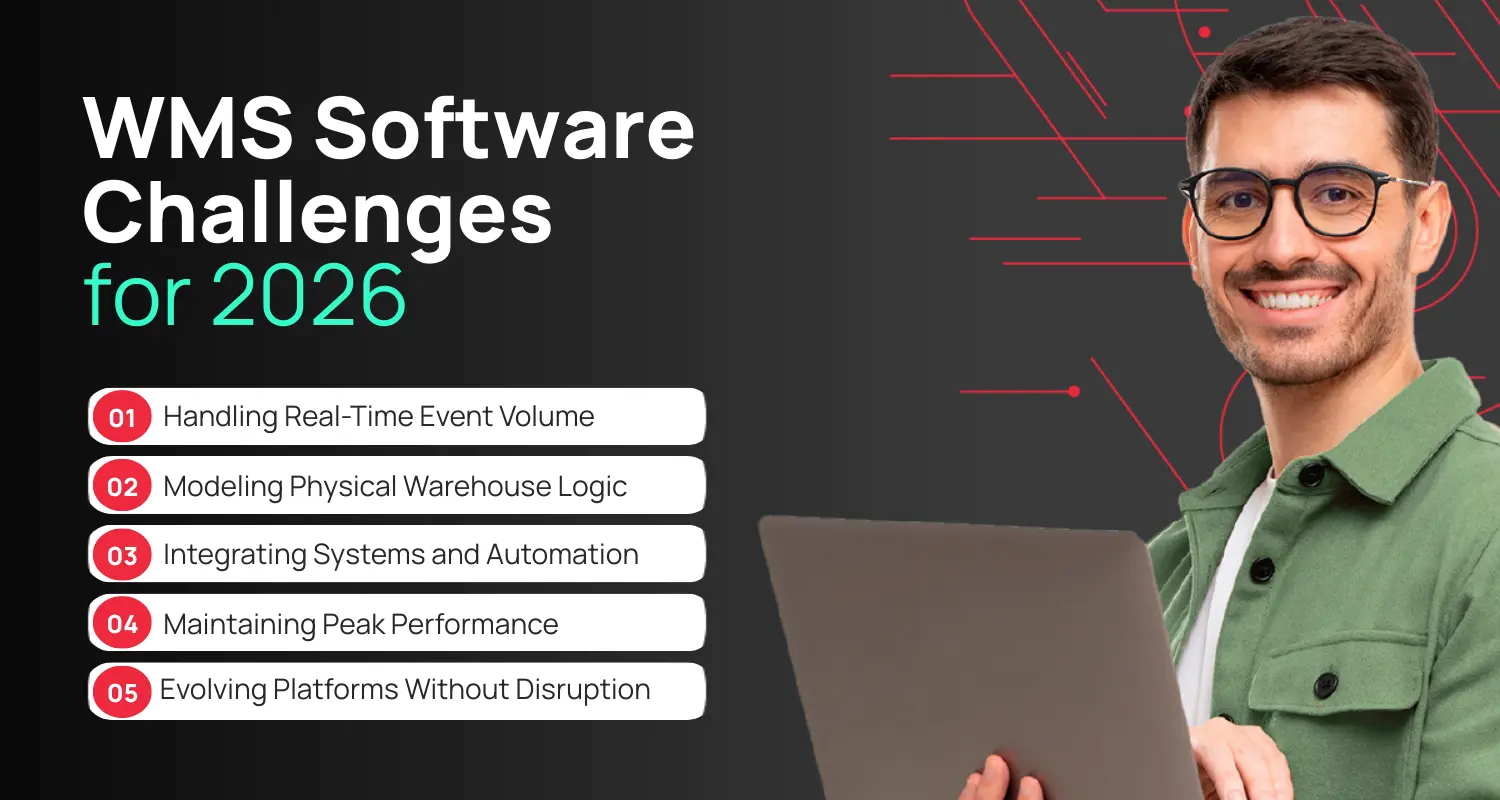
Here are the top five challenges WMS Software faces this 2026:
Managing High-Volume, Event-Driven Workflows
Warehouse operations generate continuous streams of events: item scans, location updates, pick confirmations, equipment signals, exception alerts, and more. In high-throughput environments, these events can spike dramatically during peak periods.
The challenge is not ingestion—it is coordination.
Poorly designed WMS platforms rely on synchronous workflows or tightly coupled services, creating cascading failures when volume increases. In contrast, resilient systems:
-
Use asynchronous event processing to decouple operations
-
Apply idempotent business logic to handle retries and duplication
-
Separate command execution from state projection
-
Implement backpressure and circuit-breaking mechanisms
For SaaS WMS providers, this architectural discipline directly impacts uptime, customer trust, and SLA compliance during high-demand cycles.
Designing Business Logic for Physical Operations
Unlike purely digital products, warehouse management software must reflect physical constraints. Inventory cannot be “eventually consistent” when a picker is standing in front of a shelf.
This creates a unique engineering challenge: translating physical workflows into deterministic software behavior.
Common failure points include:
-
Race conditions between automated equipment and human actions
-
Overly rigid workflows that break under real-world exceptions
-
Business rules are scattered across services instead of centrally governed
Leading teams address this by modeling warehouses as state machines, defining explicit transitions, guardrails, and exception paths. Business logic is treated as a first-class domain concern—tested, versioned, and observable.
This approach reduces operational ambiguity while enabling faster iteration as warehouse layouts and processes evolve.
Integrating Automation, Hardware, and External Systems
In 2026, a warehouse management system rarely operates alone. It must integrate with:
-
Robotics and automation systems
-
Warehouse control systems (WCS)
-
Transportation management platforms
-
ERP and supply chain management systems
-
Customer-facing SaaS platforms
Each integration introduces latency, failure risk, and data consistency challenges.
High-performing WMS platforms rely on contract-based integrations, message queues, and standardized event schemas rather than point-to-point dependencies. Hardware is treated as an external actor—not a tightly coupled dependency—allowing systems to degrade gracefully when devices fail or go offline.
This integration strategy is especially critical for SaaS vendors supporting multiple customers with heterogeneous warehouse environments.
Ensuring Performance and Reliability During Peak Operations
Peak periods—seasonal surges, promotions, or flash sales—remain the ultimate stress test for warehouse management software.
Performance issues rarely stem from raw compute limits. They are typically caused by:
-
Inefficient data models under concurrent load
-
Chatty service-to-service communication
-
Blocking workflows in critical execution paths
-
Insufficient observability during failures
Modern WMS teams design explicitly for peak behavior by:
-
Isolating read and write workloads
-
Applying horizontal scaling strategies to operational services
-
Instrumenting workflows with business-level metrics
-
Running chaos and load tests that simulate real warehouse conditions
The result is not just higher throughput, but predictable behavior when operational pressure is highest.
Balancing Platform Evolution with Operational Stability
Warehouse management software cannot pause for refactoring. New customers, regulations, automation upgrades, and fulfillment models continuously push platforms to evolve.
The challenge is enabling continuous delivery without operational disruption.
Teams that succeed treat WMS platforms as long-lived products, not finite implementations. They invest in:
-
Modular service boundaries aligned with business domains
-
Backward-compatible APIs and data contracts
-
Feature flags and controlled rollout strategies
-
Dedicated capacity for technical debt reduction
This long-term engineering mindset allows WMS SaaS providers and enterprise teams to modernize incrementally—without jeopardizing warehouse operations.
How Leading WMS Teams Evolve Their Platforms Over Time
Across both SaaS and enterprise environments, the most effective WMS teams share a common pattern: they decouple platform engineering from operational execution.
Rather than building everything in-house with a fixed team, they scale engineering capacity strategically—bringing in specialized engineers when platform complexity spikes. This includes expertise in event-driven systems, cloud infrastructure, performance optimization, and integration architecture.
By augmenting internal teams with experienced engineers who understand both software systems and operational realities, WMS organizations maintain momentum while protecting system stability.
Final Thoughts
In 2026, WMS software success is defined less by feature checklists and more by engineering execution. Systems must handle real-world complexity, scale under pressure, and evolve without interrupting operations.
For SaaS providers and enterprise product teams alike, investing in resilient architecture and experienced engineering talent is a competitive requirement.
This is where the right engineering partnership makes a measurable difference. With over 20 years of experience building complex, mission-critical platforms, Jalasoft provides access to senior engineers who understand the operational realities behind modern warehouse management systems. Supported by a cutting-edge, in-house education model,Jalasoft’s teams are trained to anticipate architectural challenges, apply proven engineering practices, and deliver software that scales with the business—today and in the years ahead.