

Senior Manager
Learn all about Jalasoft's proven strategies for Test Automation in this exclusive article!

Introduction- Why Test Automation Fails Without Strategy
Engineering teams lose 20-35% of development cycles to manual regression testing, a bottleneck that compounds with every release. For CTOs and engineering leaders managing distributed teams, this challenge extends beyond testing speed. Manual QA dependencies create release bottlenecks that delay market entry, inflate operational costs by 40-60%, and prevent teams from scaling innovation across multiple product lines.
Understanding what to automate in testing represents the difference between automation that accelerates delivery and automation that drains resources. Without a defined test automation strategy, organizations invest heavily in tools and frameworks yet fail to capture ROI. Teams automate low-value tests, struggle with brittle test suites, and watch maintenance costs eclipse the benefits automation promised.
This challenge intensifies in nearshore software development environments, where collaboration across time zones demands both agility and efficiency. The question isn’t whether to automate, it’s what to automate, when to automate it, and how to build frameworks that deliver compounding value over time.
Organizations that eliminate this bottleneck through strategic automation achieve 3x faster release velocity while reducing post-production defects by 60%. Over two decades, Jalasoft has refined a systematic approach that transforms QA from a cost center into a velocity multiplier. By implementing testing best practices in automation, we enable engineering leaders to make evidence-based decisions about automation investments that deliver measurable results: faster releases, lower costs, and higher-quality software.
What is Test Automation Strategy?
Components of Strategy
A comprehensive test automation strategy encompasses several critical elements that work together to ensure success. The foundation begins with clear objectives that align automation efforts with business goals. Technical framework selection must match project requirements while supporting long-term scalability. Resource allocation planning ensures teams have the necessary skills and tools. Finally, continuous evaluation mechanisms track progress and identify optimization opportunities.
Why Strategy Matters
Without a defined test automation strategy, organizations risk wasting resources on ineffective automation initiatives. Teams automate the wrong tests, select inappropriate tools, and struggle with maintenance overhead. A strategic approach prevents these pitfalls by establishing clear guidelines for what to automate in testing, ensuring every automation effort delivers tangible value. The strategy provides a roadmap that guides teams from initial implementation through continuous improvement.
Jalasoft’s Three-Phase Approach
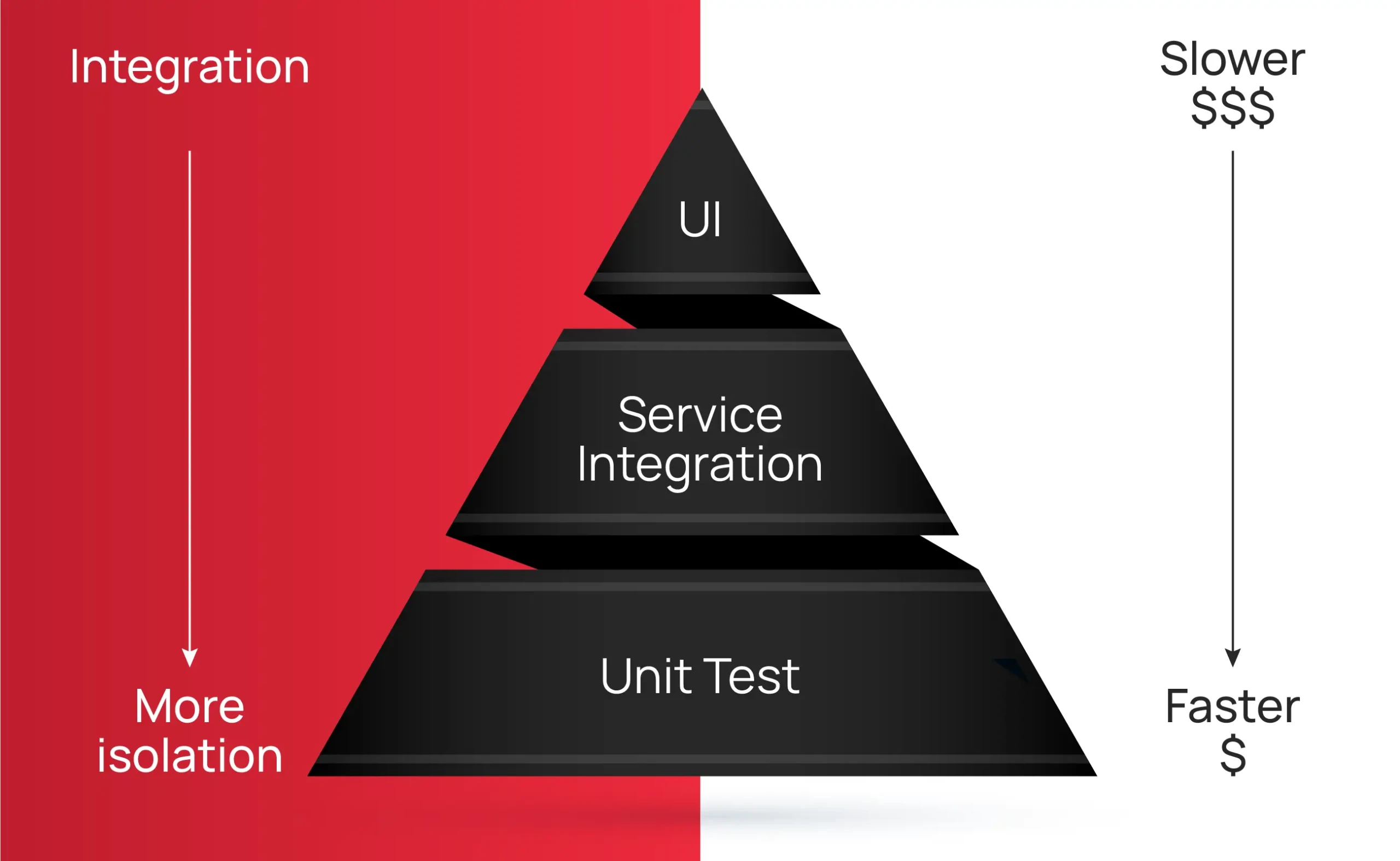
At Jalasoft, we approach automation projects as true development projects, applying rigorous test automation code strategies at multiple levels, including unit testing, service layers, and user interface. We follow the automation pyramid principle where unit tests outnumber service tests, and service tests outnumber UI tests. This distribution ensures optimal resource utilization and faster feedback loops.
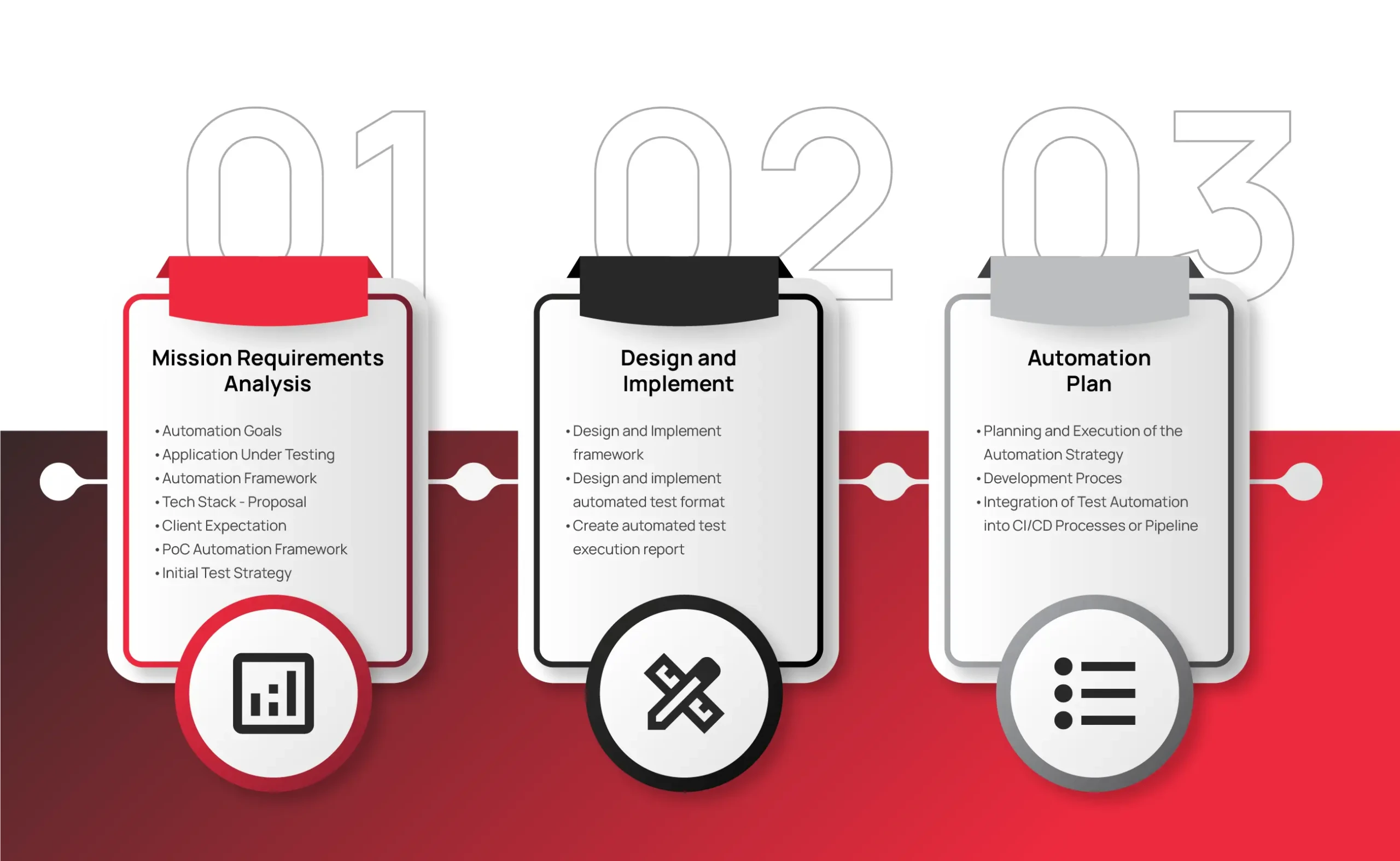
Our comprehensive approach covers three pivotal phases that establish the foundation for successful automation implementation.
1. Analysis: Reducing Manual Testing Dependency
In this initial phase, the project’s foundation is laid. Jalasoft invests time in comprehending the project’s unique requirements, grand mission, and automation goals. Potential frameworks, architectures, and tech stacks (POC) that align with the mission are explored.
2. Design: Test Automation Capabilities
The second phase translates these concepts into the actual automation framework. The structure of the tests earmarked for automation also takes shape.
3. Plan: Efficient Software Quality Assurance
In the final phase, Jalasoft articulates a tailor-made plan, charting an efficient course to accomplish the mission at hand.
This strategic approach equips Jalasoft with an unparalleled 360-degree view of deliverable quality. It ensures the establishment of swift feedback loops, offering comprehensive insights to both engineering and product teams. This approach, ultimately, leads to fewer complications in the field, lower refactoring costs, and a more satisfied user base.
What Should You Automate in Testing?
Determining what to automate in testing represents one of the most critical decisions in your automation journey. The wrong choices waste resources and deliver minimal value. The right choices accelerate delivery cycles and improve software quality. Our systematic approach helps teams identify automation candidates that provide maximum return on investment.
Tests Worth Automating
Focus automation efforts on these high-value test categories:
-
Regression tests that validate existing functionality remains intact after changes
-
Smoke tests that verify critical system functionality in build verification
-
Data-driven tests requiring multiple input variations and expected outputs
-
Tests executed frequently across multiple browsers or device configurations
-
API and service layer tests that validate backend business logic
-
Performance and load tests measuring system behavior under stress
Tests to Keep Manual
Certain test categories deliver greater value through manual execution:
-
Exploratory testing that requires human intuition and creativity
-
Usability and user experience validation, depending on subjective assessment
-
One-time tests or scenarios with extremely low execution frequency
-
Tests requiring a complex setup that would demand excessive automation maintenance
-
Visual validation of complex user interfaces with subjective quality criteria
Jalasoft’s Prioritization Framework
We employ a collaborative approach, working alongside product owners and QA teams to identify automation priorities. Our framework evaluates each potential automation candidate based on execution frequency, business criticality, stability of the feature, and maintenance complexity. This systematic evaluation guarantees return on investment in test automation by focusing resources on tests that deliver maximum value.
Our technical depth earns influence and buy-in from development teams who actively contribute to the framework and strategy. This collaboration creates a sustainable automation ecosystem where both development and QA teams share ownership of quality outcomes.
8 Essential Test Automation Best Practices
Implementing these testing best practices ensures your automation efforts deliver sustainable value and avoid common pitfalls that undermine automation initiatives.
Practice 1: Establish Clear Automation Goals and Metrics
Define specific, measurable objectives for your automation program. Establish key performance indicators such as test execution time reduction, defect detection rate, and test coverage percentage. Track these metrics consistently to demonstrate value and identify improvement opportunities. Clear goals align team efforts and provide objective criteria for evaluating automation success.
Practice 2: Select the Right Tools and Framework
Choose automation tools that align with your technology stack, team expertise, and long-term maintenance requirements. Evaluate frameworks based on community support, documentation quality, and integration capabilities. The right toolset reduces implementation friction and accelerates time to value. Consider both immediate needs and future scalability when making technology selections.
Practice 3: Implement the Test Automation Pyramid
Structure your test suite following the test automation pyramid principle with the majority of tests at the unit level, followed by service or API tests, and fewer tests at the UI level. This distribution provides faster feedback, easier maintenance, and better isolation of failures. Unit tests execute quickly and pinpoint issues precisely. API tests validate business logic without UI complexity. UI tests verify end-to-end workflows at the appropriate level.
Practice 4: Design for Maintainability and Reusability
Build automation frameworks with maintainability as a primary design goal. Implement page object models, use descriptive naming conventions, and create reusable components. Well organized code reduces maintenance burden when applications change. Modular design enables teams to update affected areas without cascading failures across the entire suite.
Practice 5: Integrate Testing into CI/CD Pipelines
Embed automated tests directly into your continuous integration and deployment pipelines. Execute appropriate test suites at each pipeline stage to catch issues early. Build verification tests run on every commit. Regression tests execute nightly or on schedule. This integration creates fast feedback loops that enable teams to address issues before they reach production. Organizations achieve faster delivery cycles, improved quality, and more efficient resource utilization through pipeline integration.
Practice 6: Standardize Test Case Structure and Language
Establish consistent patterns for writing test cases across your organization. Standardization ensures different teams speak a common domain language for both quality assurance and automation. All tests follow the same predictable structure, enabling consistency and streamlined collaboration. Tools like Cucumber with Gherkin language facilitate this standardization by providing a business-readable format that both technical and non-technical stakeholders understand. Automation testers can transition between teams with proper training on the product domain.
Practice 7: Implement Robust Error Handling and Reporting
Design tests with comprehensive error handling that provides actionable failure information. Clear error messages accelerate debugging and reduce time spent investigating failures. Implement detailed logging that captures relevant context without overwhelming developers with unnecessary information. Effective reporting presents test results in formats that support quick decision-making.
Practice 8: Invest in Team Skills and Collaboration
Build automation expertise within your organization through training, knowledge sharing, and collaborative practices. Integrate automation testers directly into scrum teams to facilitate active participation from sprint to sprint. Technical proficiency combined with domain knowledge creates teams capable of designing and implementing effective automation solutions. Foster collaboration between developers, QA engineers, and automation specialists to build shared ownership of quality.
Test Automation Framework Design
A well-designed automation framework provides the foundation for scalable, maintainable test automation. The framework architecture directly impacts execution speed, maintenance costs, and the overall effectiveness of your automation investment.
Understanding the Test Pyramid
The test pyramid serves as a guiding principle for distributing automation efforts across different testing levels. At the base, numerous unit tests provide fast, focused validation of individual components. The middle layer contains fewer integration and service tests that verify interactions between components. The top layer includes a limited number of end-to-end UI tests validating complete user workflows. This distribution optimizes for speed, reliability, and maintenance efficiency.
API, Service, and UI Testing Layers
Each testing layer serves distinct purposes in your automation strategy. API and service layer testing validates backend business logic, data processing, and system integrations without UI dependencies. These tests execute rapidly and provide precise failure localization. Service tests verify that different system components communicate correctly and handle edge cases appropriately.
UI testing confirms that user interfaces present information correctly and respond appropriately to user actions. While essential for validating end-to-end flows, UI tests require more maintenance and execute more slowly than lower-level tests. Focusing UI automation on critical user journeys while covering detailed scenarios at lower levels achieves an optimal balance.
Jalasoft’s Framework Approach
We design and implement test solutions that offer comprehensive visibility into deliverable quality with short feedback loops to engineering and product teams. Our frameworks emphasize eight key attributes that ensure long-term success.
Maintainability ensures teams can update tests efficiently as applications evolve. Robustness provides reliable execution across different environments and conditions. Efficiency optimizes execution speed and resource utilization. Readability enables team members to understand test intent quickly. Usability makes the framework accessible to testers with varying technical backgrounds. Flexibility allows adaptation to changing requirements. Extensibility supports adding new capabilities without architectural changes. Test case standardization creates consistency across the entire automation suite.
This comprehensive approach delivers fewer issues in production environments, reduced costs for later refactoring, and a more satisfied user base. Our technical expertise enables us to earn influence and buy in from development teams who actively contribute to framework evolution.
Real Case Study: 90% Time Savings
This case study demonstrates how strategic test automation implementation transformed quality assurance processes for a technology company managing four distinct web applications. The results validate our systematic approach to automation and illustrate the tangible benefits organizations achieve through proper strategy execution.
The Challenge: Manual Testing Dependencies
Our partner operated with heavy, nearly complete dependence on manual testing across their product portfolio. Their process for validating build quality proved extremely time-consuming, frequently resulting in defect discovery during late development stages. As new features were launched, regression testing duration increased progressively, creating significant difficulties in meeting release timelines.
The organization managed four distinct web applications, each utilizing different technology stacks and architectures. This diversity complicated standardization efforts and increased the complexity of implementing consistent testing approaches. The driving force behind pursuing greater test automation centered on their articulated need to scale quickly across multiple products from a development perspective to capitalize on market opportunities.
The Automation Strategy and Implementation
Following exhaustive analysis across different products and projects, we proposed creating two specialized automation sub-teams. One team focused on core structure, libraries, and reusable components. The other team concentrated on learning product domains through exploratory testing while collaborating with product owners and QA professionals to identify automation priorities for features requiring validation.
Our automation team initiated proof-of-concept exercises to validate the proposed approach. We tested various components across both the user interface and API layers. This deliberate methodology aimed to uncover potential limitations and challenges, enabling informed decisions about subsequent implementation steps.
Once we determined the optimal course of action, we implemented the core automation strategy. We adopted a test pyramid approach where the majority of tests operated at the API level, followed by end-to-end tests in the user interface. This distribution aligned with software testing best practices and provided optimal coverage with manageable maintenance requirements.
Automation testers promptly incorporated the framework into their workflows to automate tests specific to each product. We established standardized testing scenarios, ensuring clear comprehension among all team members regarding the scope and expected outcomes for each test. Test cases received careful selection and categorization based on whether they required nightly or weekly execution, aligning with our partner’s specific needs and contextual requirements.
Results and Measurable Impact
The strategic implementation delivered transformative results across multiple dimensions of software quality and delivery efficiency.
Test execution time reduction achieved a dramatic improvement, decreasing from 180 hours to 20 hours through automated test implementation. This represents a 90% reduction in testing time, enabling significantly faster release cycles.
We successfully implemented tests across all products and seamlessly integrated them into respective delivery pipelines. Automated build verification tests now validate critical functionality every night. Automated regression test suites execute every weekend, providing comprehensive validation without manual intervention.
Infrastructure cost reduction reached 60 to 70% by identifying performance issues before production deployment. Early detection prevented expensive fixes in production environments and reduced the computational resources required for testing and remediation.
Defect detection improved significantly with automated tests catching issues before new features reached production. This proactive approach reduced customer impact and enhanced overall product quality.
The comprehensive approach empowered our partner to make informed decisions regarding continuous integration practices. Manual testing dependency diminished progressively as automation coverage expanded. The organization achieved incremental acceleration in test cycles while scaling multiple products simultaneously without compromising quality standards.
Implementation of industry best practices, robust development processes, and full integration of automation testers into scrum teams created sustainable quality improvements. Automation testers actively participate in sprint planning and execution, contributing expertise throughout the development lifecycle.
Transform Your Quality Assurance with Strategic Automation
Strategic test automation transforms software quality assurance from a bottleneck into a competitive advantage. Understanding what to automate in testing, implementing software testing best practices, and executing a comprehensive test automation strategy enables organizations to deliver higher-quality software faster while reducing costs.
Jalasoft brings over 20 years of invaluable expertise in commercial nearshore software development and testing. We serve diverse international clients while developing innovative intellectual property. Our team of 400 highly skilled engineers specializing in quality assurance actively engages in more than 60 projects focused on test automation excellence.
We possess a deep understanding of testing best practices and actively contribute to shaping industry standards. Our extensive experience enables us to excel across multiple technology stacks, various product configurations, including web, mobile, and cloud platforms, and adapt to numerous engineering processes and methodologies.
Partnering with Jalasoft provides immediate access to proven expertise, seamless team integration, strong ownership mentality, and consistent delivery of software at the highest quality standards.
Get Started with Expert Test Automation Services
Ready to enhance your software quality and delivery efficiency? Partner with Jalasoft for comprehensive test automation services that deliver measurable results. We streamline development processes, minimize manual testing dependencies, and ensure high-quality software delivery.
Get in touch with our experts today to discuss how strategic test automation can transform your quality assurance processes.